Marketplace vs. Own Website: The Ultimate E-Commerce Strategy for Scaling Your Brand
One of the most important decisions every e-commerce brand faces is how to structure its sales channels.
- Should you focus on building your own website and brand presence?
- Or should you prioritize selling on marketplaces where customers already exist?
For years, this has been framed as a binary decision.
In reality, the most successful brands in 2026 are not choosing between the two — they are combining them into a unified growth strategy.
Understanding how to balance marketplaces and direct-to-consumer (DTC) channels is what separates brands that grow slowly from those that scale globally.
The Evolution of E-Commerce Channels
E-commerce has gone through several phases:
- Phase 1: Own website dominance (early Shopify era)
- Phase 2: Marketplace explosion (Amazon, retail marketplaces)
- Phase 3: Multi-channel ecosystems
Today, consumers interact with brands across multiple touchpoints: marketplaces, social media, and brand websites.
👉 Brands must be present wherever customers are.
Understanding Marketplaces (And Why They Dominate)
Marketplaces have become the fastest-growing segment in e-commerce. Platforms powered by Mirakl enable retailers to transform into scalable ecosystems where multiple brands can sell under one platform.
Key Characteristics
- Large built-in customer base
- High purchase intent
- Strong trust signals
- Standardized buying experience
Why Consumers Prefer Marketplaces
- Convenience (everything in one place)
- Price comparison
- Faster delivery options
- Established credibility
Advantages of Selling on Marketplaces
1. Immediate Access to Traffic
One of the biggest challenges in e-commerce is acquiring customers. Marketplaces eliminate this problem by providing organic traffic, search visibility, and high intent users. Instead of spending heavily on ads, brands can tap into existing demand.
2. Higher Conversion Rates
Marketplace users are typically closer to making a purchase. This results in higher conversion rates, lower acquisition cost per order, and faster sales cycles.
3. Trust & Credibility
Customers trust established platforms more than unknown brands. This reduces purchase hesitation, cart abandonment, and customer acquisition friction.
4. Faster Market Expansion
Marketplaces allow brands to enter new countries quickly, test demand, and scale without heavy investment.
The Limitations of Marketplaces
Despite their advantages, marketplaces are not perfect. Key limitations include:
- Commission fees
- Limited brand control
- Restricted customer data access
- Increased competition
This is why relying only on marketplaces is not a complete strategy.
Advantages of Your Own Website (DTC)
Your website is your brand’s digital home.
1. Full Control Over Brand Experience
You control your design, messaging, and the entire customer journey — end to end.
2. Higher Profit Margins
No marketplace commissions means higher margins per sale.
3. Customer Data Ownership
Owning your customer data allows retargeting, email marketing, and loyalty programs.
4. Long-Term Brand Equity
Your website builds long-term brand value — not just transactions.
The Problem with Choosing Only One Strategy
Many brands make one of two mistakes:
❌ Mistake 1: Website-Only
- High marketing costs
- Slow growth
- Limited reach
❌ Mistake 2: Marketplace-Only
- Dependency on platforms
- Lack of brand identity
- Reduced customer ownership
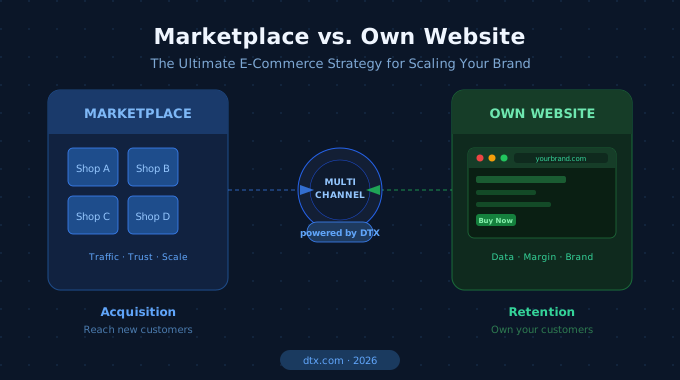
The Winning Approach — Multi-Channel Strategy
The most effective approach combines both channels into a unified system:
🛒 Marketplace = Acquisition Channel
- Drive traffic
- Generate sales
- Enter new markets
🌐 Website = Retention Channel
- Build relationships
- Increase lifetime value
- Strengthen brand
How DTX Enables Multi-Channel Growth
DTX (Digital Trade Exchange) provides the infrastructure to manage multi-channel e-commerce efficiently. By leveraging marketplaces powered by Mirakl, DTX allows brands to scale across multiple platforms from a single system.
Key Capabilities:
- Multi-marketplace integration
- Centralized product management
- Unified order flow
- Integrated logistics solutions
- AI-driven marketing optimization
This eliminates the complexity typically associated with multi-channel expansion.
Practical Strategy for Brands (Step-by-Step)
Step 1: Start with Marketplaces
- Validate product demand
- Generate initial revenue
- Build brand exposure
Step 2: Build Your Website
- Create brand identity
- Develop customer relationships
Step 3: Integrate Both Channels
- Sync inventory
- Align pricing
- Create consistent messaging
Step 4: Optimize with Data
- Track performance per channel
- Adjust strategy accordingly
Common Mistakes to Avoid
- Ignoring logistics scalability
- Inconsistent pricing across channels
- Poor product listings
- Lack of brand differentiation
The Role of Logistics in Multi-Channel Strategy
Managing multiple channels requires strong logistics infrastructure. Without it, orders get delayed, costs increase, and customer experience suffers. DTX integrates logistics solutions to support multi-channel growth efficiently.
Future Trends in E-Commerce Strategy
Looking ahead, we see several powerful shifts shaping the industry:
- Increased marketplace dominance
- Growth of retail media
- AI-driven operations
- Expansion of cross-border commerce
Brands that adapt early will gain a significant advantage.
Conclusion
The question is no longer: Marketplace or website?
👉 How do you combine both into a scalable system?
Brands that adopt a multi-channel strategy will grow faster, reduce risk, and build stronger brand equity.
Ready to Scale Your Brand?
Ready to scale your brand across marketplaces and beyond? Book a free consultation with DTX and unlock multi-channel growth.